 By Antonio De Rosa, ADR Studio.
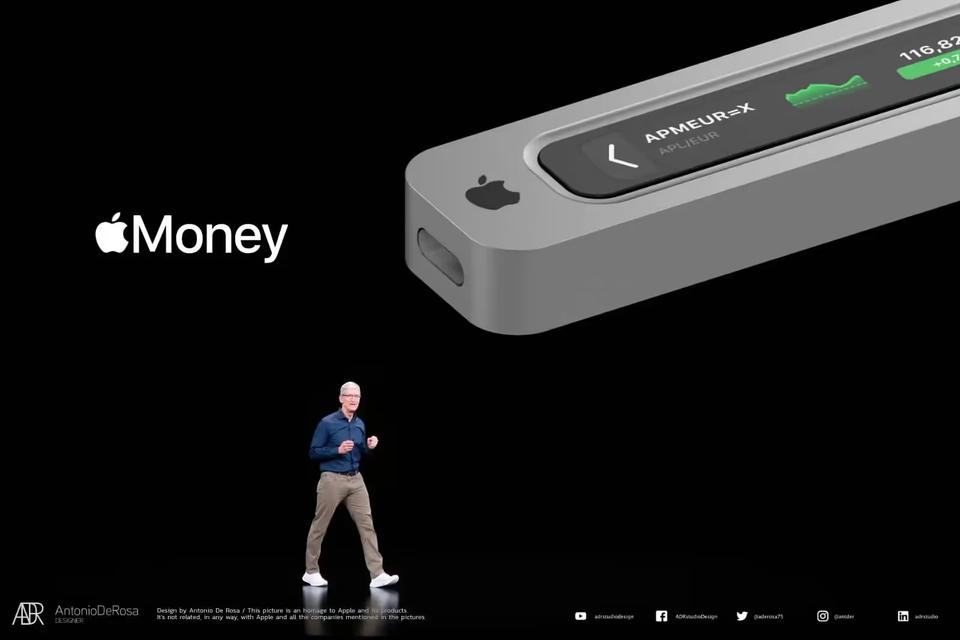
Our Apple digital wallet concept explores how Apple might bring its own currency and an integrated electronic wallet into everyday use. Created by ADR Studio in 2022, Apple Money connects a clear financial proposition with intuitive interfaces and considered transaction flows. It is an independent concept, not an Apple product.
What is the Apple digital wallet concept?
Apple Money is a conceptual digital wallet and currency framework. Its starting point is a question about the relationship between a technology brand and financial services: how could Apple enter digital currency and cryptocurrency without losing the simplicity associated with its user experience?
The brief brought together three connected ambitions. The experience should feel intuitive. Security should inform the way people move through it. And the currency and wallet should make sense within a wider ecosystem, rather than feel like separate additions.
This was not a proposal to put a familiar visual identity over an unfamiliar financial product. The idea was to explore how design could make that product easier to understand. A restrained interface matters, but so does the logic beneath it.
Where does the design story begin?
Everything starts from a dot. Here, that dot was the possibility of a currency and a wallet conceived together. One defines what people could use. The other defines how they would encounter and manage it. The concept needed to connect both.
Read as a making-of, the story moves from that premise towards the interface. First comes the value proposition: a connected financial experience shaped around simplicity, security and integration. Then comes the design language. Finally, the interaction flows make those intentions tangible.
These are the layers through which we can explain the project, rather than a claim about a documented sequence of sketches or prototypes. The finished concept provides the focus: an elegant user interface, streamlined onboarding and transaction flows intended to support secure use.
The central design question stays consistent throughout. What does a person need to understand before they can act with confidence?
How does an idea become an interface?
A concept becomes more concrete when its promise can be expressed through a sequence of decisions. For Apple Money, that means considering the journey into the wallet alongside the experience of using the currency. Neither should require a different mental model.
The design language draws on Apple’s minimal, user-centred identity. That gives the project a clear reference, but minimalism alone is not the answer. Removing visual noise is useful only when the remaining information helps someone understand their position and their next action.
The project’s design logic can be understood through three connected layers:
- Proposition. Bring a conceptual currency and an electronic wallet into one coherent financial experience.
- Interface. Use an intuitive, restrained design language rooted in the brand’s approach to everyday interactions.
- Flow. Connect onboarding and transactions so that simplicity is part of the journey, not just the appearance of a screen.
This is where strategy and craft meet. A value proposition gives the interface a purpose. The interface gives that proposition a form people can navigate.
What does simplicity mean in a financial experience?
In finance, simplicity cannot mean leaving people unaware of what an action does. It should mean reducing unnecessary effort while preserving the information needed to make a decision. That distinction is central to reading Apple Money as a design exploration.
Streamlined onboarding forms part of the concept. The ambition is a clear route into the experience, consistent with the intuitive interaction expected from the wider brand. A wallet should not feel approachable at its entrance and become difficult once someone starts using it.
Transaction flows extend the same principle. Each step has to belong to the same experience. The concept positions security and ease of use as requirements to consider together, rather than competing qualities to resolve through appearance alone.
Systems, not styles. A minimal interface can set the tone. Consistent interaction logic is what makes that tone meaningful across the journey.
How can design communicate security without claiming to prove it?
Apple Money envisioned a secure financial experience. That is a design intention, not evidence of an implemented security system. A concept can explore how transactions should be presented and understood. It cannot, through interface design alone, demonstrate that a currency or wallet is technically secure.
This boundary matters. Familiar visual language may help an experience feel approachable, but familiarity does not replace protection. The role of the design is to consider how people encounter financial actions without treating a polished screen as proof of safety.
The same distinction applies to ecosystem integration. Apple Money explores what a connected experience could feel like. It does not establish a live connection to Apple services or describe an available financial product.
Keeping these limits visible makes the project easier to discuss on its own terms: a considered proposal about user-first digital finance.
What does the finished concept bring into focus?
The finished concept brings the currency framework, wallet interface and interaction flows into one design proposition. Its craft lies in their relationship. The visual restraint should support the journey, and the journey should express the promise of an integrated experience.
Viewed as a showreel, the story is not simply a transition from an early idea to a polished screen. It is a movement from possibility to clarity. What might this service offer? How might someone enter it? How could its financial interactions remain understandable?
Apple Money does not answer those questions with a launched product or measured results. It gives them a form that can be examined. That is the contribution of the concept: making a possible direction for digital finance concrete enough to discuss, question and develop.
Key takeaways.
- Apple Money is an independent ADR Studio concept from 2022, not an official Apple product.
- It explores a digital currency and integrated wallet through one connected design proposition.
- The concept centres on intuitive interfaces, streamlined onboarding and transaction flows intended to support secure use.
- Its value is exploratory. It invites discussion about user-first finance without claiming implementation or measured outcomes.
FAQ.
Is Apple Money an official Apple service?
No. Apple Money is a concept created by ADR Studio in 2022. It explores how Apple might approach a digital currency and wallet. It is not presented as a commissioned or released Apple service.
What does the Apple Money concept include?
It includes a conceptual currency and digital wallet framework, an elegant user interface, streamlined onboarding and transaction flows shaped around security, simplicity and ecosystem integration.
What can this project teach us about financial design?
It shows why the proposition, interface and interaction flows need to be considered together. Clear design can help make a financial idea understandable, while remaining distinct from the technical work required to build and secure it.