 By Antonio De Rosa, ADR Studio.
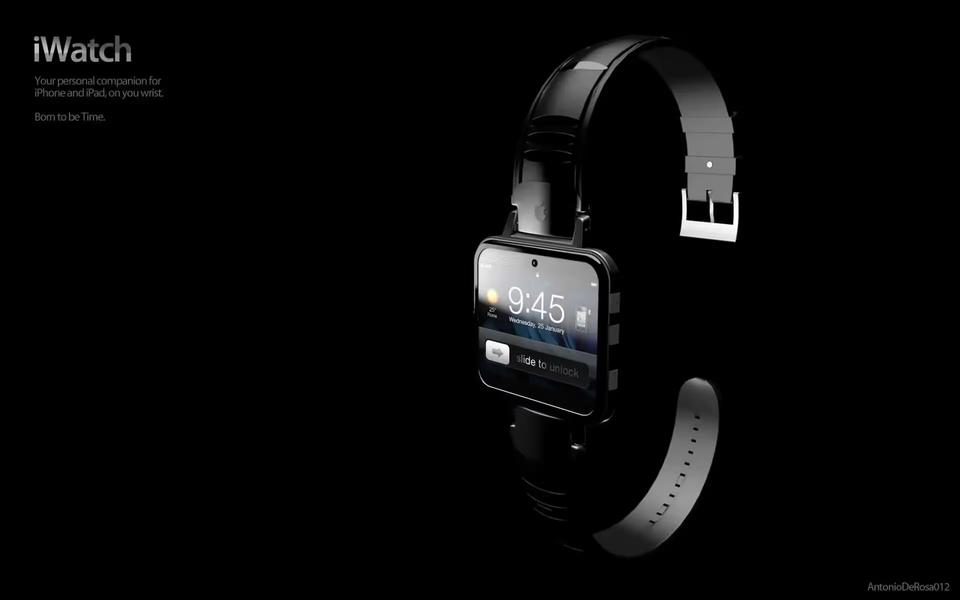
ADR Studio’s iWatch2 2012 explored smartwatch concept design before mainstream adoption, bringing minimal aesthetics, intuitive controls and forward-looking interaction into one wearable proposal. Its purpose was to imagine a next-generation personal device before the market and technology were fully mature.
Created in 2012 for Concept by ADR Studio, the project asked what a possible evolution of wearable technology could feel like. Not simply what it might contain, but how its form and interface could belong together. That relationship gives this story its sequence: context, intention, proportion, interaction and the finished concept.
What did smartwatch concept design mean in 2012?
The context matters. Wearable technology had not yet reached mainstream adoption, and the conditions for a next-generation smartwatch were still developing. The iWatch2 2012 concept worked within that uncertainty. It proposed a direction rather than presenting an established product category as a settled brief.
For us, the creative opportunity was to look ahead without making complexity the subject. A personal wearable needed to feel understandable as an object, not only interesting as an idea. Minimal visual language and ergonomic form were therefore part of the same question: how could future technology feel natural to use?
The project explored that question through a conceptual smartwatch. It was a possible evolution, not a claim that the market or technology had already arrived.
Where does the design story begin?
Everything starts from a dot. Here, that starting point was a clear intention: balance simplicity, function and elegant proportions in a device worn close to the body.
That intention provides a useful way to read the making-of. Before considering a finished appearance, consider the relationships the concept needed to hold together. The object had to suggest a future-facing device while remaining visually restrained. Its controls had to feel intuitive. Its interaction ideas had to support, rather than compete with, the physical form.
This is the design logic behind the story, rather than a reconstruction of an undocumented sketch or prototype sequence. The supplied project context establishes the ambition and the resulting concept. It does not establish individual production steps.
- Context: imagine a wearable before mainstream adoption.
- Idea: make future interaction feel approachable.
- Form: bring ergonomic thinking and elegant proportions together.
- Interface: pair intuitive controls with anticipatory ideas.
How do proportions carry the idea?
In this concept, minimal aesthetics were not separate from function. They were part of how the wearable could communicate its purpose. A restrained object asks its proportions to do more of the visual work. The relationship between the overall form and the interface becomes central to how the design is understood.
The iWatch2 2012 proposal combined that restraint with ergonomic thinking. It treated the wearable as a personal object, not just a place to put technology. That distinction matters when reading the finished concept: the form and the interaction belong to one design problem.
The ambition was to feel both timeless and ahead of its time. Those aims can pull in different directions. Here, minimal visual language offered continuity, while the interaction thinking explored what might come next. The craft lay in holding both within a coherent proposal.
How can an interface look forward without adding complexity?
The project paired intuitive controls with anticipatory interface ideas. That combination is important. Looking ahead does not have to mean making an interface visibly complicated. It can mean asking how a personal device might become easier to understand as its role develops.
Within the iWatch2 2012 concept, interface thinking supported the broader balance of simplicity and function. The proposal explored future interaction without making a catalogue of features the centre of the story.
There is a useful boundary here. The project description does not specify particular gestures, applications, sensors or predictive capabilities. Anticipatory design should therefore be understood as an area of exploration, not evidence of a named technical system. The meaningful point is the relationship: forward-looking interaction ideas were considered alongside minimal aesthetics and ergonomic form.
How does the concept unfold as a showreel?
Read as a showreel, the project has a clear progression. Start with the question of a future personal wearable. Move towards the object and its proportions. Then consider the controls and interface. Finally, read those elements together as a finished concept.
This sequence shifts attention from appearance alone to the decisions the appearance expresses. It also keeps the presentation grounded. There is no need to add a fictional workshop, material experiment or engineering milestone to explain the design.
- Establish the possibility. Introduce a smartwatch imagined before mainstream adoption.
- Focus on the form. Read the minimal language, ergonomic intent and elegant proportions.
- Bring interaction into view. Connect intuitive controls with forward-looking interface thinking.
- Return to the whole. Present simplicity and function as a shared ambition.
The finished concept is the point where these ideas meet. The story moves from a broad possibility to a coherent wearable proposal, without confusing a conceptual presentation with a record of manufacture.
What does iWatch2 2012 show about concept work?
The project showcased ADR Studio’s ability to envision international product trends early and inform future creative exploration in wearable interfaces. Its contribution was exploratory: it made a possible direction visible while the surrounding market and technology were still developing.
That is a distinct role for design. A concept can bring questions of use, form and interaction into one object so they can be considered together. It does not need to claim commercial success or technical validation to serve that purpose.
Looking back at iWatch2 2012, the relevant thread is not a prediction scorecard. It is the discipline of imagining what could come next while keeping the proposal clear. Systems, not styles: form, controls and interface considered as connected decisions.
Key takeaways.
- iWatch2 2012 explored a possible smartwatch evolution before mainstream adoption.
- The concept brought minimal aesthetics, ergonomic form and elegant proportions together.
- Intuitive controls and anticipatory interface ideas supported its forward-looking intent.
- Its value lay in exploring a direction, not claiming a manufactured product or measured outcome.
FAQ.
What is the iWatch2 2012 concept?
It is a conceptual smartwatch created in 2012 for Concept by ADR Studio. It explored how a next-generation personal wearable could balance simplicity, function, minimal aesthetics and forward-looking interaction.
Was iWatch2 2012 a commercially released smartwatch?
The project is described as a concept. The available information does not establish a commercial release, manufacturing programme or tested production device.
What was the central design idea?
The central idea was to combine minimalist visual language, anticipatory interface thinking and ergonomic form. Together, these elements proposed a wearable intended to feel both timeless and ahead of its time.